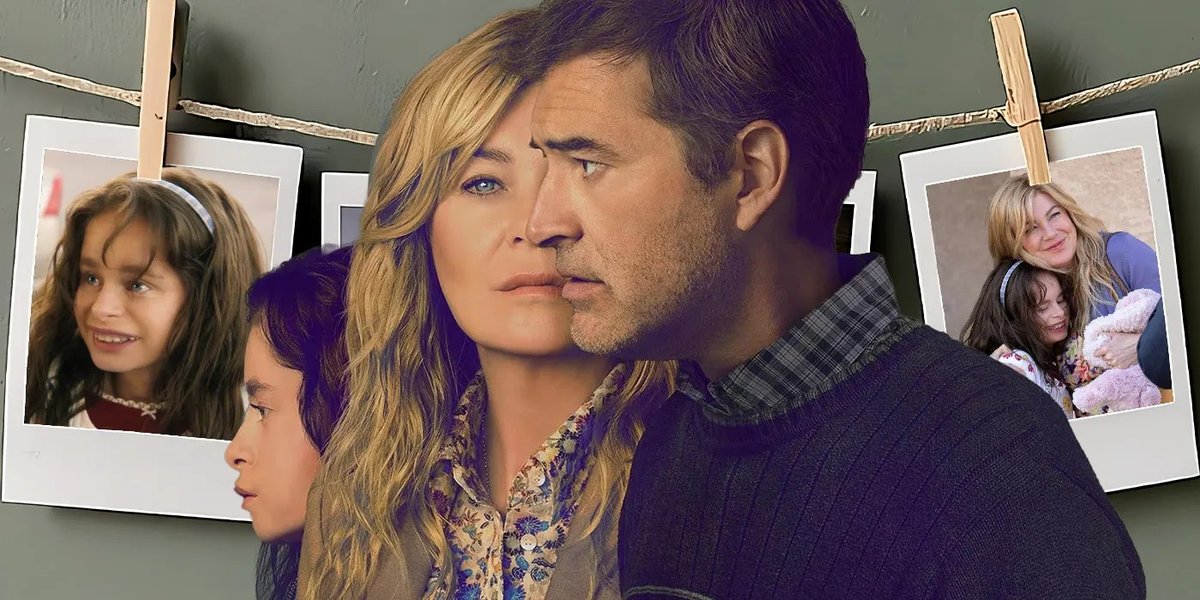
The notion of the "Good American Family" has long been a bedrock of our cultural identity, a picturesque ideal often painted in broad strokes across films and TV. But what happens when that ideal collides with the messy, often uncomfortable realities of true life? When stories like that of Natalia Grace explode onto our screens, demanding we look beyond the glossy facade, we’re forced to grapple with Defining the 'Good American Family' in True Story Films & TV in a far more complex and nuanced way. The recent Hulu limited series "Good American Family" doesn't just tell a story; it challenges us to dissect our own deeply held beliefs about family, truth, and what we perceive as "good."
This isn't about simple heroes and villains. It's about peeling back layers, questioning narratives, and acknowledging the profound influence that media has on shaping our understanding of real people and their profoundly complicated lives. As journalists and critical viewers, we must ask: how do these dramatizations shape our collective consciousness, and what responsibility do they bear in presenting the multifaceted truth?
At a Glance: Decoding the "Good American Family" in True Stories
- The Ideal vs. Reality: True-story adaptations frequently expose the vast chasm between our idealized notions of family and the often harsh, ambiguous realities.
- Media's Power: Films and TV have immense power to frame narratives, sway public opinion, and impact the lives of real individuals involved in these stories.
- The Natalia Grace Case: This specific saga highlights the complexities of adoption, disability, truth perception, and legal systems.
- Ethical Storytelling: Creators face significant ethical dilemmas in adapting real events, balancing dramatic impact with factual accuracy and respect for privacy.
- Critical Viewing: Audiences must engage critically, questioning perspectives, seeking multiple sources, and recognizing the inherent biases in any mediated story.
- Evolving Definitions: The "Good American Family" is not a static concept; true-story narratives often force us to expand and redefine our understanding of familial bonds.
The Natalia Grace Saga: A Brief, Unsettling Background
To understand how the "Good American Family" archetype is challenged, we first need to grasp the unsettling true story at the heart of the Hulu series. In 2010, Kristine and Michael Barnett adopted Natalia Grace, a Ukrainian orphan with spondyloepiphyseal dysplasia congenita, a rare form of dwarfism. They believed she was a 6-year-old girl. What followed was a spiral of accusations: the Barnetts claimed Natalia was a sociopathic adult masquerading as a child, citing alleged pubic hair, adult teeth, and menstruation.
These claims led to a shocking legal maneuver in Indiana: the Barnetts successfully petitioned to change Natalia's birth year from 2003 to 1989, legally declaring her 22 years old. They then moved to Canada with their three biological sons, leaving Natalia behind in an apartment in Lafayette, Indiana. This abandonment eventually led to neglect charges against Kristine and Michael Barnett in 2019. Michael was acquitted in 2022, and Kristine's charges were later dismissed in 2023, with courts largely focusing on Natalia's disability rather than her disputed age due to the legal change.
Natalia's journey continued to twist. After being abandoned, she was taken in by a neighboring family, the Manses, and later officially adopted by them in 2023, despite her claims of an abusive experience there, which she detailed in her own docuseries, "The Curious Case of Natalia Grace." Adding another layer to the mystery, a DNA test conducted in 2023 and released in early 2024 indicated Natalia was approximately 22 years old at the time of the test, implying she was indeed 9 years old when adopted by the Barnetts in 2010. Natalia has consistently denied the Barnetts' allegations. Today, she lives with the DePauls, a family of little people who had attempted to adopt her back in 2009. The Hulu series, Is Good American Family based on a true story?, captures these intensely opposing perspectives, offering no easy answers.
Deconstructing the Myth: What is the "Good American Family" Anyway?
Before we dive deeper into the Natalia Grace story's implications, let's unpack the very concept we're discussing. The "Good American Family" is less a sociological definition and more a cultural construct. Historically, it conjures images of the nuclear family: two parents (often heterosexual, married), 2.5 children, a house with a white picket fence, a dog, and an unwavering sense of harmony. It signifies stability, morality, upward mobility, and a certain wholesome, aspirational ideal.
This image has been meticulously cultivated and reinforced by generations of media—from classic sitcoms like "Leave It to Beaver" and "The Brady Bunch" to advertising campaigns for everything from breakfast cereal to life insurance. It’s a powerful narrative, deeply embedded in our collective consciousness, suggesting that this particular structure is the ultimate source of happiness, success, and societal contribution.
However, reality, even in the mid-20th century, was far more diverse and complex. Today, with shifting societal norms, diverse family structures, and increasing awareness of mental health and socio-economic pressures, that monolithic ideal feels increasingly outdated, even oppressive. The "Good American Family" as a static archetype often fails to account for adoption, divorce, blended families, single-parent households, LGBTQ+ parents, chosen families, and the myriad challenges that real families face. True-story films and TV, by their very nature, are uniquely positioned to dismantle this myth, offering a window into the raw, unvarnished truth that often exists far from the ideal.
True Stories on Screen: The Perilous Path from Reality to Reel
The magnetic pull of "true story" adaptations is undeniable. We are fascinated by real-life drama, by the idea that these extraordinary events actually happened to ordinary people. This genre promises authenticity, a glimpse behind the curtain of curated lives, and often, a moral lesson. But the path from reality to reel is fraught with peril, particularly when the story involves living individuals and deeply personal traumas.
Filmmakers and showrunners face immense pressure to create a compelling narrative. This often involves making difficult choices about what to include, what to omit, how to portray characters, and which perspective to emphasize. The very act of adapting a true story into a dramatic format inherently involves interpretation, selection, and sometimes, outright embellishment for the sake of pacing, character arc, or emotional impact. This is where the ethical tightrope walk begins.
The "Good American Family" series exemplifies this challenge. It presents "opposing perspectives," a journalistic approach designed to offer a balanced view. Yet, even with this intent, the way scenes are framed, dialogue is delivered, and background music is chosen can subtly (or not-so-subtly) steer audience sympathies. Whose story gets the most screen time? Whose emotional beats are amplified? Whose claims are given more weight through visual cues or editorial decisions? These are not minor details; they are fundamental choices that profoundly impact how we, the audience, define "good" and "bad," "victim" and "perpetrator." The series invites us to be the jury, but it's a jury often influenced by the curated evidence presented through the lens of dramatic television.
Natalia Grace: Challenging Our Preconceptions of Family & Morality
The Natalia Grace case is a potent mirror reflecting our societal biases and preconceived notions about family, morality, and disability. The central contention – whether Natalia was a child or an adult – fundamentally shifts the entire narrative. If she was a child, the Barnetts' actions are seen as abandonment and neglect of a disabled minor. If she was an adult, their claims of sociopathic deception become more credible, transforming them from alleged abusers into victims.
This ambiguity forces us to confront uncomfortable questions:
- The Nature of Truth: In an era of competing narratives and "he-said-she-said" content, how do we discern truth? Is it purely factual, or is it also emotional and experiential? Natalia's consistent denial of the Barnett's allegations, coupled with the later DNA evidence, pushes back against their narrative, but the court's focus on her legally changed age muddied the waters.
- Disability and Perception: Natalia's rare form of dwarfism played a crucial role. Did her appearance contribute to the Barnetts' suspicions, or did it make her more vulnerable to exploitation and manipulation of her age? How do societal perceptions of disability—from infantilization to assumptions of cunning—influence how we interpret her story?
- Defining Parental Responsibility: What does it mean to adopt a child, especially one with special needs? What are the boundaries of parental rights and responsibilities, and at what point does a family's struggle cross into abuse or neglect? The legal changes and subsequent abandonment force a harsh spotlight on these ethical quandaries.
- The "Good" Parent Myth: The Barnetts, on the surface, were a family with biological children, outwardly successful, embodying many elements of the "Good American Family" ideal. Their adoption of a child with special needs could even be seen as a benevolent act. The allegations and subsequent legal battles shatter this facade, revealing the fragility of outward appearances and the darkness that can sometimes lurk beneath.
The Natalia Grace story challenges our innate desire for clear-cut morality. It's not a narrative where one side is wholly good and the other entirely evil. Instead, it’s a swirling vortex of confusion, suspicion, fear, legal complexities, and competing versions of reality, making the task of judging "good" or "bad" exceedingly difficult.
The Power of Perspective: How Films & TV Shape Our Judgment
When a true story is adapted for the screen, the filmmakers become powerful arbiters of perspective. Their choices in framing, editing, casting, and even musical score can dramatically alter how an audience perceives the events and the people involved.
Consider the "he-said-she-said" dilemma inherent in the Natalia Grace case. The Hulu series aims to present both sides. However, presenting "both sides" is rarely a neutral act.
- Framing and Visual Cues: Is one party consistently shown in a sympathetic light (soft lighting, intimate camera angles) while another is portrayed with harsh lighting or unsettling music? Are childhood photos of Natalia used effectively to evoke empathy, or are older, more ambiguous images strategically placed to sow doubt?
- Editorial Choices: Which testimonies are given more airtime? Are contradictions highlighted or downplayed? Are expert opinions presented in a way that supports one narrative over another?
- Character Portrayal: How do the actors embody the real people? Do they lean into certain traits that might reinforce a particular interpretation (e.g., making one character seem genuinely distraught and another cold or calculating)?
- Narrative Arc: Even in a "true story," there's an inherent desire for a compelling narrative arc—a beginning, middle, and resolution. This can sometimes lead to simplifying complex motivations or omitting details that don't fit neatly into the chosen storyline, ultimately shaping our judgment of the characters' morality.
The danger here is that viewers, often unfamiliar with the raw, unfiltered evidence, can easily internalize these curated perspectives as the objective truth. This is why critical viewing is paramount.
Navigating Nuance: How to Watch True-Story Content Critically
Engaging with true-story films and TV shows like "Good American Family" requires more than passive consumption. To truly understand the complexities and avoid succumbing to biased narratives, you need to become an active, critical viewer.
Here's how to navigate the nuance:
- Question the Source and Intent:
- Who made this? What might be their agenda (entertainment, advocacy, profit)?
- Who is telling the story, and whose perspective is prioritized?
- Is it a documentary, a docuseries, or a dramatic reenactment? Each has different conventions and levels of factual fidelity.
- Recognize the Human Element of Storytelling:
- Even "true" stories are shaped by human choices—what to film, what to cut, what questions to ask.
- No story can ever capture 100% of reality. What might be missing?
- Seek Multiple Perspectives (Beyond the Screen):
- Don't rely solely on one series or film.
- Read independent journalistic accounts, court documents (if available), and other analyses. Listen to interviews with different parties involved. Natalia's own docuseries, for example, offers a different lens.
- Identify Emotional Manipulation:
- Pay attention to music, lingering close-ups, voiceovers, and editing choices. Are they designed to make you feel a certain way about a character or event?
- While empathy is natural, be aware when emotions are being manufactured to obscure facts.
- Look for Ambiguity and Contradictions:
- Real life is messy. If a story feels too neat, too black and white, it might be an oversimplification.
- Are there unanswered questions? Unexplained shifts in character behavior? These are often indicators of deeper complexities.
- Differentiate Between Fact and Interpretation:
- Just because someone says something on screen doesn't make it an undisputed fact. It's their perspective.
- Look for corroborating evidence, not just emotional testimony.
By adopting a critical lens, you move beyond being a mere spectator and become an informed participant in the ongoing dialogue about these complex, real-life dramas.
Beyond the Screen: The Real-World Impact on Families
While we consume these true stories for entertainment or enlightenment, it’s crucial to remember that they have profound, lasting real-world impacts on the families and individuals involved. For the Barnetts, the Manses, Natalia Grace, and the DePauls, their lives are not just a narrative; they are a lived experience, forever altered by the public gaze and media portrayal.
- Privacy and Reputation: True-story adaptations inherently strip away privacy. Every detail, every accusation, every vulnerability becomes public domain. Reputations can be irrevocably damaged, even if legal outcomes later vindicate individuals. The Barnetts, regardless of their legal findings, will forever be associated with the accusations made against them.
- Trauma Re-lived: For victims of alleged abuse or neglect, revisiting these stories, whether through participation or simply seeing them on screen, can re-traumatize. Even those accused, if they genuinely believe their own version of events, can experience immense psychological distress.
- Legal Consequences and Public Opinion: While courts deliver legal judgments, public opinion, heavily influenced by media, often delivers a moral verdict that can be far more enduring. This can affect employment, social standing, and personal relationships long after a series has aired.
- The Children Involved: In cases like Natalia's, there are other children involved—the Barnetts' biological sons. How does this public drama affect their lives, their relationships with their parents, and their own sense of family?
Filmmakers and viewers alike bear a responsibility here. Creators must weigh the public interest against the potential harm to real people. Viewers must remember that behind every character on screen is a human being with a life that extends far beyond the confines of a TV series.
The Uncomfortable Truth: Why These Stories Endure
Why are we so endlessly drawn to these complex, often dark true stories about families? Why do tales like Natalia Grace's resonate so deeply, even as they challenge our comfort zones?
The answer lies in our fundamental human nature:
- Fascination with Anomaly: We are captivated by stories that deviate wildly from the norm, especially when they involve institutions we hold sacred, like family. The idea of a child potentially being an adult, or parents abandoning a disabled minor, shatters our expectations and forces us to confront the unthinkable.
- Search for Meaning: In these narratives, we often seek to understand the "why." Why did this happen? What does it say about human nature, societal structures, or the justice system? We look for lessons, warnings, or confirmations of our own worldview.
- Reflection of Our Own Fears: These stories tap into our deepest anxieties about trust, deception, vulnerability, and the fragility of relationships. Could this happen to us? Could we misjudge someone so profoundly? Could our own family unit be secretly fractured?
- Moral Exploration: True stories provide a rich ground for moral and ethical debate. They invite us to wrestle with right and wrong, even when the lines are blurred, and to consider the complexities of human motivation that lead ordinary people to extraordinary actions.
- Human Connection (Even Through Conflict): Ultimately, these are stories about people. Despite the drama and the darkness, there's an inherent human desire to connect with and understand others' experiences, even if those experiences are vastly different from our own.
These stories endure because they hold up a mirror, not just to the families involved, but to society itself, reflecting our values, our fears, and our endless quest to understand the human condition.
Reframing "Good": An Evolving Definition for Modern Audiences
The Natalia Grace story, like many other true-story films and TV series that explore the dark underbelly of domestic life, forces us to question and ultimately redefine what we mean by the "Good American Family." It shatters the notion of a pristine, monolithic ideal and replaces it with something far more intricate, more authentic, and ultimately, more resonant with modern life.
"Good" is no longer about adhering to a specific structure or maintaining a flawless facade. Instead, it's about:
- Resilience: The capacity to endure hardship, adapt to change, and find strength in adversity.
- Empathy and Understanding: The ability to see beyond initial impressions, to try and comprehend diverse experiences and perspectives, even when they are challenging.
- Accountability: Taking responsibility for actions, seeking truth, and striving for justice.
- Unconditional Love (within healthy boundaries): A commitment to care and support, recognizing the complexities and imperfections inherent in all human relationships.
- Adaptability: The willingness to evolve, to embrace new structures and forms of kinship that reflect the diversity of contemporary society.
The "Good American Family" isn't found in a picture-perfect ideal, but in the gritty, often messy reality of people trying their best (or sometimes failing spectacularly) to navigate the profound and often contradictory demands of familial bonds. True-story films and TV, when handled with integrity and viewed with critical awareness, are not just entertainment; they are vital tools for our collective re-education, helping us move beyond simplistic notions to embrace a richer, more compassionate understanding of what it means to be a family in America today. They challenge us to look closer, listen harder, and ultimately, to expand our own definition of "good."